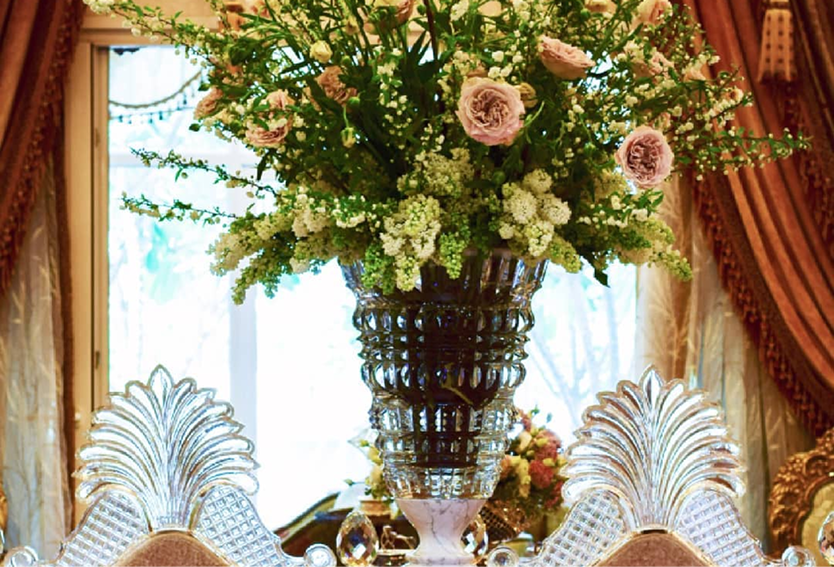
There is a moment, at nearly every Arabic wedding, when the room seems to exhale all at once — low seating arranged in a wide, generous circle, gold catching candlelight from every angle, the scent of oud settling over everything like a second kind of lighting. It is a moment built from centuries of hospitality customs, refined over generations into something that now reads, to the modern eye, as pure luxury.
But to understand why Arabic wedding décor looks the way it does is to understand that almost nothing in that room is decorative in the purely aesthetic sense. Every element — the seating, the palette, the scent, the scale — carries meaning that long predates the word “wedding décor” as an industry term. Designing within this tradition, particularly in a city as design-forward as Dubai, means holding two things at once: deep respect for what each element has always meant, and enough creative confidence to let that meaning speak in a genuinely contemporary voice.
The Global Influence of Arabic Luxury
This is also a tradition that has, in many ways, shaped what the rest of the world now recognises as luxury wedding aesthetics. Long before gold accents and dramatic drapery became a global wedding design trend, they were simply how hospitality was expressed in this region — generous, warm, and unafraid of abundance where abundance was appropriate. Designing an Arabic wedding today, then, is not a matter of applying luxury to a tradition, but of understanding that the tradition largely defined what luxury has come to mean in this context in the first place.
That distinction changes how we approach every decision that follows, from where a Majlis grouping sits in a room to how a single lantern is hung above it.
The Majlis as the Emotional Centre of the Room
To understand Arabic wedding décor, one has to start with the Majlis, because nearly everything else in the room is designed in relation to it. Traditionally a gathering space for conversation, hospitality, and the passing of time among family and honoured guests, the Majlis carries a set of expectations that go well beyond furniture arrangement. Seating is low, generously cushioned, and arranged to face inward, encouraging conversation rather than a single fixed point of attention.
This inward orientation is deliberate; it signals that the gathering itself, not a stage or a spectacle, is the true centre of the occasion. Recreating this at scale, for a wedding reception that might host several hundred guests, is one of the more technically demanding aspects of Arabic wedding design. The seating has to remain low and intimate in feeling even when multiplied across dozens of groupings, which means careful attention to sightlines, spacing, and the subtle staggering of heights.
Rich textiles — velvet, brocade, and heavily embroidered fabrics — are used generously here, not merely for visual richness but because touch and texture have always been part of how hospitality is communicated in this tradition. A guest should be able to sink into a cushion and feel, immediately, that comfort and welcome were considered before anything else.
Gold, White, and the Language of Celebration
If there is one visual signature that reads as unmistakably Arabic wedding décor anywhere in the world, it is the pairing of gold and white. White traditionally signals purity and new beginnings, while gold has long been associated with abundance, celebration, and status — a colour that, quite literally, catches and multiplies light, making a room feel larger and more radiant than its physical dimensions might suggest.
Together, the two colours create a palette that manages to feel both deeply traditional and inherently luxurious, which is precisely why it has remained the foundational palette for Arabic weddings even as broader design trends have shifted around it. What has evolved, particularly in Dubai’s more contemporary wedding scene, is the range of golds now considered appropriate within this palette. Where a single, uniform bright gold once dominated, designers today are far more likely to layer several distinct metallic tones together — a warmer antique gold alongside a cooler brushed brass, a matte gold finish set against a high-polish accent.
This layering technique allows the palette to read as contemporary and considered rather than simply traditional, while never abandoning the symbolic pairing that gives it meaning in the first place. White, similarly, has expanded to include ivory, bone, and soft cream tones, chosen for how they interact with gold under candlelight rather than how they might photograph under flat daylight alone.
Lighting, in fact, is what ultimately determines whether a gold-and-white palette succeeds or falls flat. Gold under harsh, cool-toned lighting can read as brassy or artificial, while the same tone under warm, low candlelight becomes rich and luminous almost by itself. This is why the most carefully designed Arabic weddings treat lighting design and palette selection as a single, inseparable decision.
Oud, Scent, and the Sense Design Often Forgets
Visual design tends to dominate conversations about wedding décor, but in Arabic wedding tradition, scent has always carried equal weight, and oud in particular occupies a place of real significance. Burned as incense to welcome guests, oud’s deep, resinous fragrance is inseparable from the experience of Arabic hospitality; its presence signals that a space has been prepared with care, in the same way a beautifully set table signals preparation in other traditions.
For many guests, the scent of oud entering a room registers on a level well below conscious thought — an immediate, physical cue that a celebration of real significance is underway. Incorporating scent thoughtfully into modern wedding design means treating it with the same intentionality given to lighting or floral choices, rather than as an afterthought handled separately from the rest of the décor plan.
Diffusion needs to be considered in relation to room size, ventilation, and the length of the event, since a scent that feels welcoming at the moment guests arrive can become overwhelming if concentration builds unchecked across several hours. The most successful modern Arabic weddings treat oud diffusion almost as a lighting designer treats a dimmer switch — building it in gradually, adjusting its presence as the evening deepens.
There is also a growing appreciation for pairing oud with subtler, complementary scents drawn from florals or fresh greenery used elsewhere in the décor, rather than relying on oud alone to carry the entire sensory experience of the room. A space that layers a warm base note of oud with lighter, fresher accents tends to feel more dimensional than one relying on a single fragrance throughout.
Lanterns, Drapes, and the Architecture of Enclosure
Beyond seating and palette, Arabic wedding décor has a distinctive relationship with enclosure — the way a space is wrapped, framed, and softened using drapery and lanterns rather than left as a single open room. Sweeping fabric ceilings, cascading drapes along walls, and lanterns suspended at varying heights all work together to transform even a very large venue into something that feels intimate and contained, echoing the enclosed, sheltering quality of a traditional tent or Majlis structure.
This is a very different spatial philosophy from the open, sightline-driven design common in many Western wedding aesthetics, where transparency and unobstructed views are often prioritised. Lanterns in particular carry layered symbolism, associated historically with guidance, hospitality, and the welcoming of travellers into a space of safety and rest. Modern interpretations have moved well beyond traditional metal and glass forms, with designers now working in blown glass, brass filigree, and even suspended candle clusters designed to catch and scatter light across a drape-lined ceiling.
The goal, in every case, remains the same: to make a guest feel enclosed within something warm and considered, rather than exposed within an open, undefined space. Achieving this at scale requires careful structural planning, since drapery and suspended lighting both depend heavily on a venue’s ceiling height, rigging points, and airflow, all of which have to be assessed and solved well before a single lantern is hung.
Fabric selection for large-scale drapery also demands more technical consideration than its finished appearance suggests. The solution, in most large-scale Arabic wedding installations, is layering — a heavier base fabric providing structure and richness, with a lighter, sheerer layer draped over or alongside it to catch movement and light without undermining the overall sense of weight and luxury the design is meant to convey.
Multi-Day Celebrations and Evolving Décor
Arabic weddings frequently unfold across several distinct events rather than a single day — an engagement gathering, a Henna night, and the main wedding celebration itself, each carrying its own tone, guest composition, and level of formality. Designing décor for this kind of multi-day arc requires thinking in terms of narrative progression rather than a single fixed aesthetic, so that each event feels connected to the others while still offering its own distinct character.
A Henna night, traditionally more intimate and often centred around the bride and close female relatives, might lean into deeper, more saturated colour and a more relaxed, floor-seated Majlis arrangement, while the main wedding celebration scales upward into the full gold-and-white grandeur guests associate with the tradition at its most formal.
Managing this progression well means establishing a small number of consistent design elements — a signature floral form, a particular metallic tone, a recurring textile pattern — that appear, in varying intensity, across every event in the sequence. This creates a sense of continuity for guests attending multiple celebrations across several days, while still allowing each individual event room to feel purpose-built for its specific moment. It is, in many ways, decorative choreography as much as static design, requiring a production timeline and logistical plan every bit as detailed as the visual concept itself.
Honouring Tradition While Designing for Today’s Couple
Perhaps the most delicate task in modern Arabic wedding décor is holding tradition and personal expression in the same hand without letting either overwhelm the other. Couples today are, in many cases, deeply connected to these traditions while also wanting their wedding to reflect their own individual taste — a bride who wants full Majlis styling but has always been drawn to a more minimalist visual sensibility, a groom whose family expects a certain scale of celebration but who personally prefers restraint over abundance.
Navigating this well requires a designer willing to ask, specifically and directly, which traditional elements matter most to a couple and their families, rather than assuming every element of the tradition must appear at full intensity by default. The most successful Arabic weddings we have designed in recent years share a particular quality: they never feel like a checklist of expected symbols assembled dutifully into a room, nor do they feel like tradition has been abandoned in favour of pure contemporary aesthetics.
Instead, they feel like a considered, personal interpretation — full Majlis seating rendered in an unexpected, more minimal material palette; gold used with real restraint rather than saturating every surface; oud diffused thoughtfully rather than overwhelmingly. This is design work that requires genuine cultural fluency alongside aesthetic skill, and it is, in our experience, exactly what today’s couples are asking for: not a departure from what came before them, but a version of it that feels unmistakably their own.
This balance is, in many ways, a conversation that has to be revisited with every single family we work with, since no two families hold tradition in quite the same way. Some couples want every element rendered exactly as it has always been, finding comfort and meaning in continuity rather than reinvention. Others arrive wanting to keep only the elements that feel personally essential to them, reworking everything else into a more modern visual language. Neither instinct is more correct than the other; the work of a good designer is simply to listen closely enough to understand which instinct a particular couple and their families are bringing into the room.
The work of a good designer is simply to listen closely enough to understand which instinct a particular couple and their families are bringing into the room, and to build a celebration that honours that instinct fully, rather than imposing a single fixed formula onto every Arabic wedding regardless of the people actually getting married. That is how tradition becomes not a constraint, but the most generous kind of foundation.